the experience of hearing an opera is that you accumulate a lot of details that are not very significant in themselves. no one of the details in an opera (or in a novel) is a mind-boggling detail. but things just keep coming until you have a huge pile of them. that’s when they start meaning something.
[…]
i’m trying hard, in perfect lives, to reproduce the music of the way people talk. it’s not poetry, it’s song. it’s song in the same way that, i suppose, the iliad was a song. it’s just a song — if you read any one line, it’s not that interesting in itself, but if you read a hundred they start to make sense. it gets into your mind. it’s not really a refinement of language, it’s just a huge number of details that make up a story.
-robert ashley
perry and i have recently started off on our second attempt at book-clubbing walter benjamin’s unfinished arcades project (our first, years ago, having been thwarted by the long section on baudelaire), a book that, once you’ve gotten a taste, becomes nearly impossible to stop seeing resonances with wherever you look. that’s a quality it shares for me with the work of robert ashley, who described his television opera (a form he invented and could never quite define) perfect lives as “a collection of sayings.” in january, i programmed a screening of perfect lives at local microcinema/vhs store whammy! analog media through tape, a nonprofit i volunteer with (who operate in part out of an office in a curtained-off back corner of whammy), and in the process of putting this screening together, i reread the libretto of perfect lives and devoured as much critical writing on or by ashley as i could track down. these twin readings have shaded my approach to basically everything i’ve encountered over the past two months or so, from agnés varda’s film daguerréotypes and georges perec’s essay-of-sorts the rue vilin, both portraits of the shops that line their respective parisian neighborhoods’ main drags, to lászló krasznahorkai’s the melancholy of resistance1, where the narrative perspective is frequently jolted out of focus by interrupting fragments of vernacular speech, metaphorical turns of phrase and bits of interior narration – these works struck me as collections of sayings in their own right, accumulations of details, attempts to apply unconventional critical frameworks to contemporary sociocultural life and experience. to ashley, modern life can be approached as an opera; to benjamin, an arcade, and both are things that can be read in the same fashion any other text.
i spent a friday in early february bumming around culver city, initially meeting my friend rosalind at the wende museum. i’ve been to the wende a few times over the years across multiple locations of theirs and have always found the experience quite striking – ostensibly, they are a museum of eastern european cold war history built around a world-class collection of artifacts from that era, but that undersells the strangeness of their work and the way the guest interfaces with it. when i mentioned to a friend where i was going, he told me he’d always wanted to visit, mentioning that he got the impression that it was some sort of “lefty museum.” i’m not quite so sure, and i don’t think i’d really describe it in political terms at all! it’s certainly not exactly a traditional cold war museum – the two largest temporary exhibits on display were an installation from cuban contemporary artist enrique martínez celaya recreating his father’s house on a sugar plantation in sculptural form and a gallery on the collaboration between architects victor adegbite and charles polónyi in post-colonial ghana, hardly what you’d expect between the german name and the fragments of the berlin wall out front. the most distinct thing i remember from my one trip to the museum’s prior home in an office park is the way a visit took you into the bowels of the archive rather than doing the interpretative work for you – there were curated displays with descriptive text, but the sheer mass of stuff is what strikes you. the new location, a converted national guard armory, doubles down – the curated portions of the permanent collection are dwarfed by wall-to-wall, floor-to-ceiling bankers boxes displayed behind glass, labeled according what sort of material artifacts they hold. opposite these walled-off display cases showcasing sealed boxes are open library stacks of soviet books with no explicit organizing schema, once again shelved wall-to-wall, floor-to-ceiling, only interrupted by a window into the film archives showing us the stacks of cans of celluloid without showing us their contents. the fine art collection is behind a locked glass door, but peeking inside, you can see the frames packed on the shelves, with the art itself reliably facing away from the viewer, leaving us to reckon with the collection as an object in of itself without giving us the tools to explore the specifics. less a museum “about” the cold war in particular, it seems to be to be a museum about the work of historiography and engagement with the archive, about the ways museums communicate information to their guests, the way the voice of authority is received by listeners and and the ways that information’s presentation can obfuscate or twist the meaning, and the museum encourages viewers to think outside of the limited context of its collection. in the small display on propaganda, there’s a mention in the text that the soviet union was not the only state that produced propaganda, and in fact, much of the propaganda emerging from the united states looked quite similar, it’s just that they don’t collect that propaganda. it’s not a lefty museum – rosalind joked that we could never bring our stalinist friends, who’d be furious seeing the soviet union painted as any sort of remotely regressive regime – but it’s hardly a right-wing political project either; it ultimately feels more to me like a mcluhan-ish “anti-environment,” a conceptual art project designed to force a confrontation with the ways in which media and museums mediate, with the cold war subject matter of its archive almost being incidental to the larger approach. from the wende, i walked over to downtown culver city, stopping in at the museum of jurassic technology for a cup of tea and the center for land use interpretation2 next door to check out their exhibit on borax production and borate mining in southern california.
in fall of 2022, a bout of covid rewiring my travel plans had me ultimately roaming the northeastern corridor for about a month. i fell ill after a family wedding in the hudson valley and a visit to niagara falls3, and after a week quarantining in buffalo, a night in south norwalk, ct crashing with a friend who happened to be recovering simultaneously and a few nights in a motel in the outer ring suburbs of dc waiting to test negative, i spent a week staying with cousins in dc proper and another week or so with my great aunt in manhattan. the wedding was what brought me to the hudson valley, but while there, i made a point to visit harvey fite’s opus 40 and dia beacon, and while i was far too ill in buffalo to responsibly or comfortably visit the burchfield penney art center4 or hallwalls, once in dc i visited several smithsonian institution museums as well as three private museums in the area (the phillips collection, the kreeger museum and glenstone), and in nyc i visited the moma and the brooklyn museum as well as pausing to listen to max neuhaus’s times square.
i’ve talked before with friends about not really understanding sculpture as a medium when it’s not in some way site-specific, reacting to or altering the environment around it. it’s not that i can’t appreciate the craftsmanship, it’s not that there aren’t sculptures i find aesthetically or conceptually satisfying (or, in less needlessly obtuse terms, yes, “sculptures i like”), it’s more that i simply don’t know what to do with most of it. i can practically live in a great painting, a great record, a great book, but i don’t know how to live in, say, a sculptural bust or an assemblage piece. i have seen very few sculptures in my life that meaningfully connected with me, and the ones that have connected are typically monumental in scale and inexorably tied with their surroundings. opus 40 stands out even among these, not least because it was at one point primarily intended as the surroundings themselves, not the sculpture. its architect (for lack of a better term) harvey fite initially purchased the quarry that would become his final and most famous work as a source of raw material for his work in carved stone, but over the years, the plan shifted, and after a stint attempting to sculpt it into an appropriate open-air gallery to display his statues, he realized that what he was constructing was a statue in its own right and spent the rest of his life working on it, ultimately dying in an accident on-site in 1976.
almost every photo i’ve seen of opus 40 centers on its most visually prominent feature, an obelisk placed at the sculpture’s highest point, and as such, most representations of the piece seem to live in the misinterpretation that even fite himself initially held – that this place is intended primarily for the display of something else. the traditional photo a visitor takes of opus 40 is not of the sculpture at all but merely of its capstone. my on-site, in-person experience with the work felt radically different from everything i’d seen of it in photographs – it is not something you look at but something you move through, full of hidden spaces, subterranean passageways, stepped terraces and sunken pools, an environment reclaimed from the carved-out negative space of industrial production, built in situ from the materials extracted from the site. to focus on the obelisk treats the sculpture as a museum built to exhibit work, a perception fite attempted to avoid by moving his other sculptures elsewhere on site after his realization that opus 40 was the sculpture rather than the garden. fite was primarily a figurative sculptor who came of age pre-war, not part of the generation of conceptual artists that popularized land art (starting work on opus 40 as most of them were only just being born), but this popular visual representation of his final work as a massive open-air museum displaying a quite literally monolithic work has resonances with the writings of later earthworks pioneer robert smithson (who, like fite, died on the job, in a plane crash while surveying possible sites for his sculpture amarillo ramp):
history is a facsimile of events held together by flimsy biographical information. art history is less explosive than the rest of history, so it sinks faster into the pulverized regions of time. history is representational, while time is abstract; both of these artifices may be found in museums, where they span everybody’s own vacancy. the museum undermines one’s confidence in sense-data and erodes the impression of textures upon which our sensations exist. memories of “excitement” seem to promise something, but nothing is always the result. those with exhausted memories will know the astonishment.
visiting a museum is a matter of going from void to void. hallways lead the viewer to things once called “pictures” and “statues.” anachronisms hang and protrude from every angle. themes without meaning press on the eye. multifarious nothings permute into false windows (frames) that open up onto a verity of blanks. stale images cancel one’s perception and deviate one’s motivation. blind and senseless, one continues wandering around the remains of europe, only to end in that massive deception “the art history of the recent past.” brain drain leads to eye drain, as one’s sight defines emptiness by blankness. sightings fall like heavy objects from one’s eyes. sight becomes devoid of sense, or the sight is there, but the sense is unavailable. many try to hide this perceptual falling out by calling it abstract. abstraction is everybody’s zero but nobody’s nought. museums are tombs, and it looks like everything is turning into a museum. painting, sculpture and architecture are finished, but the art habit continues. art settles into a stupendous inertia. silence supplies the dominant chord. bright colors conceal the abyss that holds the museum together. every solid is a bit of clogged air or space. things flatten and fade. the museum spreads its surfaces everywhere, and becomes an untitled collection of generalizations that immobilize the eye.
–some void thoughts on museums, robert smithson, 1967
smithson, for his part, thought this aspect of the museum was a feature rather than a bug, as he explained in a 1967 conversation with allan kaprow:
I think the nullity implied in the museum is actually one of its major assets, and that this should be realized and accentuated. The museum tends to exclude any kind of life-forcing position.
[…]
I’m interested for the most part in what’s not happening, that area between events which could be called the gap. This gap exists in the blank and void regions or settings that we never look at. A museum devoted to different kinds of emptiness could be developed. The emptiness could be defined by the actual installation of art. Installations should empty rooms, not fill them.
in beacon, new york, the dia art foundation’s flagship museum occupies a former nabisco box-printing plant, a fact which would presumably make smithson, a devotee of the post-industrial landscape and one of the artists represented in their collection, very happy. when i visited dia beacon in 2022, i found myself fairly frustrated with a lot of the works on display, although it’s not exactly inaccurate for a survey of the history of the conceptual art movement to be dominated by a small handful of (mostly white, mostly male) artists coming to nearly identical conclusions about what constitutes artistic radicalism in a world of stifling tradition – a seemingly blank canvas, perhaps hung off center (if hung at all), a bare plywood form insisting that it too is sculpture, a line drawn from wall to wall that actively surveys the room rather than simply allowing itself to be passively situated within it. indeed, these are radical and disruptive acts… in the context of an art gallery world that had never seen these things before, not the context of each other. there are endless ways to paint a canvas white and i have no doubt there are many more yet to be discovered, but putting a half dozen artists making the same gestures in adjacent rooms hardly serves the things that make the work innovative or exciting. so many artists working in so many mediums, yet here they all are, triangulating the corners of the same rooms with different materials or hanging their similar canvases at slightly different angles to each other. to me, it made the radicalism of this art hard to grasp or define and felt like something closer to the “meme” take on the work, inspiring the sort of “huh, that’s wild… is that it? really?” reaction that one tends to have on their first encounter with, say, cage’s 4’33” or similar boundary-busters. it was a very disappointing and memorable response to have, especially considering the fact that i actually quite like a lot of this art5! quite frankly, i don’t think of myself as creative enough to come up with anything half as inventive or disruptive as what that generation of artists did, and anything i might come up with is necessarily informed by the groundwork they laid, but to see it all together, presented so austerely and seriously, cheapened it to such an extent that i’m still haunted by it 3.5 years later. curatorial narrative snuffing out the work’s vitality… what alternatives might be possible?
sick in bed in a hotel in buffalo, cooped-up, too brain-fogged to get any reading done, my only window overlooking an industrial back alley, i watched james benning’s two films on smithson’s spiral jetty: casting a glance, from 2007, and measuring change, from 2016. at the time of this writing, i don’t drive, which makes a personal encounter with smithson’s earthwork along the great salt lake quite difficult6 – i know spiral jetty through his film of the same name, his writings, and a variety of secondary sources. benning’s movies are among those sources. to quote benning:
i have a very simple definition of an artist: the artist is someone who pays attention and reports back. a good artist pays close attention and knows how to report back. i teach a course called “looking and listening.” the class and i practice paying attention. i take them to many different places, often for a full day, and we look and listen. sometimes we go to an oil field in the central valley, or to a mountaintop to watch the sky brighten as the sun begins to rise, or to a homeless neighborhood in downtown los angeles, or to the port at long beach. we gradually learn that our looking and listening are coded by our own prejudices, that we interpret what we see through our own particular experiences, and we learn that we need to confront our prejudices and learn to see and hear more clearly. and to learn more about what we do see.
benning’s own definition (as good as many others i’ve heard) would of course leave the man himself as a canonical artist to be reckoned with – few others fit the bill he’s defined better; i’ve seen plenty of “landscape films” try and fail. however, being a canonical observer of the american landscape does not necessarily equip someone to wrestle with the immensity of a sui generis work of art – his spiral jetty films are both perfectly fine, but with my trip to dia beacon on the brain, i couldn’t help but wonder how successful they are as curatorial appropriative acts in the context of art viewership. smithson’s own film on spiral jetty exists in geologic time and cosmic space and attempts to situate the work in that context, and as fanciful as that is, benning’s earthbound approach doesn’t seem to me to interpret smithson’s “mud, salt crystals, rocks, water” at all, content to literally display it. it’s a very good display, but it mostly feels to me like someone else doing the work of looking for the viewer, which is not something most of benning’s work makes me feel. if i wanted to “measure time,” i’d be better served going out and doing so for myself, with no carefully controlled framing to guide me. no matter how good someone else’s eyes may be, it’s hard to engage directly with the work through them.
glenstone, a private museum outside of dc, takes yet another approach. here, the curation pretends at an invisible touch – there are no informational placards to be found anywhere, with the works of art situated across the campus in one of a few small buildings or along a meandering path. the works displayed are listed on the website, but if you’re standing in a gallery and want to know more about the art you’re looking at, the recommended course of action is not to consult the online directory but ask a docent (often a local art school grad, as i understand it), who will typically answer politely and ask you some open-ended questions about the art to get your juices flowing – how does it make you feel? what does it remind you of? the galleries and occasional outdoor sculpture are dwarfed by the landscaping, which like all of the architecture and most of the art, leans towards the contemporary, polished and finely-wrought. an environment manicured in such a way that sculptures by jeff koons, michael heizer and andy goldsworthy don’t look out of place hardly comes across as natural at all, much less unbiased or informal – for better or for worse, this is as deliberate and constructed an experience with art as you can get anywhere. the glenstone team – the outlandishly wealthy and seemingly soon-to-be-divorced emily and mitch rales – discuss the project in terms of controlling the viewer’s attention; the goal is to “create spaces where meaningful encounters with art are not just possible, but central” and the work is displayed in “spaces designed to facilitate meaningful encounters.” the museum is always free with reservations (or as a walk-up if you take public transit, as i did), but they only allow 600 reservations per day – simultaneously “accessible” and exclusive, typically booked out months in advance, a carefully controlled artificial space, nominally public but privately owned (with the billionaire curators i believe living on site), designed with the single goal of forcing a certain sort of engagement with a certain kind of art. is this any better? i’m not so sure!
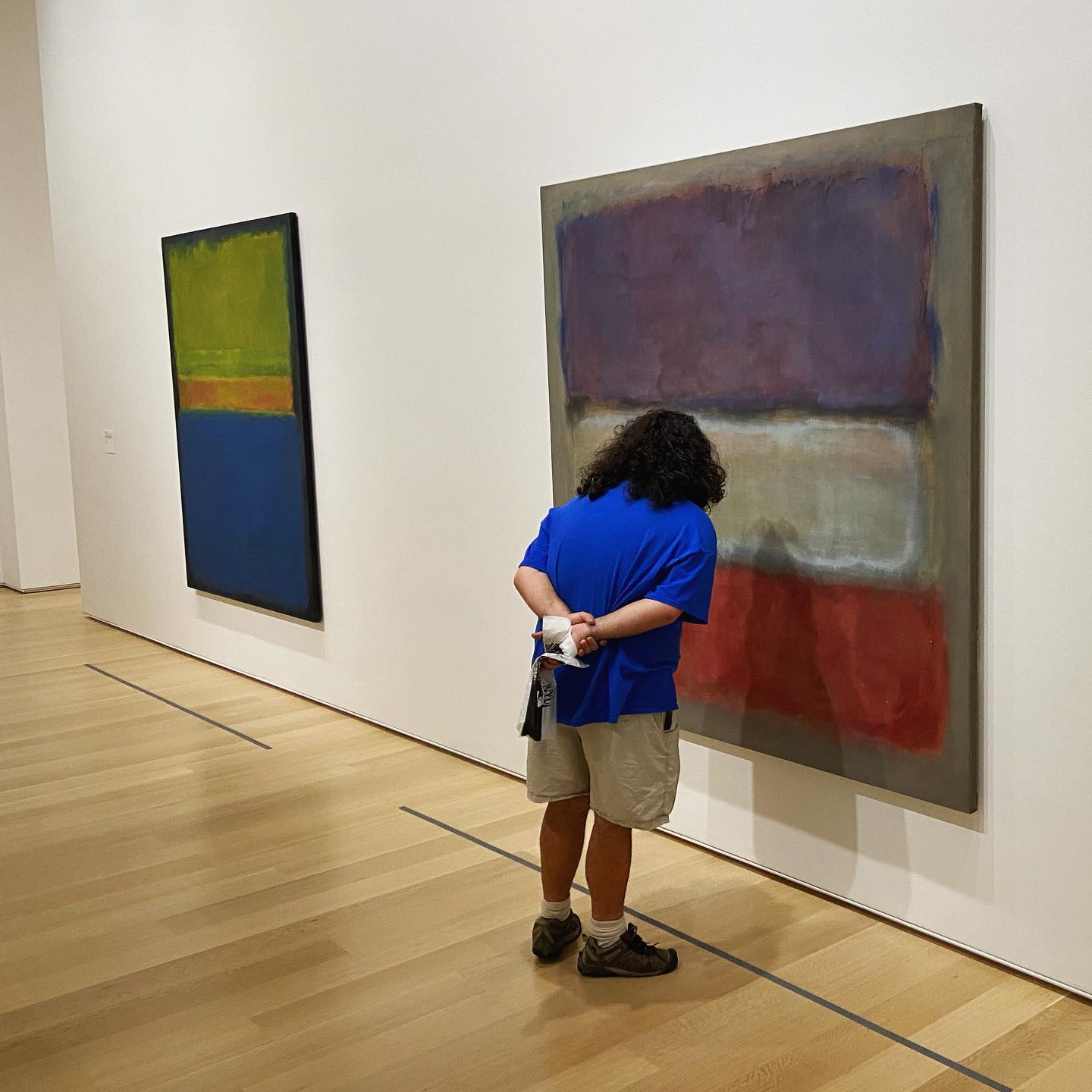
in dc proper, if my count is correct, i saw 21 paintings by mark rothko. 17 of them were in a large, well-lit room in the national gallery of art7 and 4 of them were in the phillips collection’s rothko room, which is the only staging of his works designed in full collaboration with the artist and executed to his specifications. this certainly wasn’t my first time seeing rothko paintings in person, nor was it my first time seeing a large volume of them shown together (i’d seen a dozen or so in a room at the art institute of chicago a few years earlier, pictured below), but the differences between the two rooms created a sharp contrast. at the national gallery, i flashed back to one of my favorite rooms at dia beacon, showcasing andy warhol’s shadows paintings – a huge number of identically-sized and similarly-composed canvasses breathlessly packed on the walls in a ring around the edges of the gallery, allowing the viewer to study the subtle or not-so-subtle variations; this strategy works a lot better for me when it’s applied to a clearly delineated subsection of a single artist’s body of work rather than a career survey or multiple artists working along similar lines. next door at the national gallery was barnett newman’s stations of the cross series, which i was quite struck by, but the gigantic well-lit roomful of decades worth of rothko was simply too much to take in at once. each of these canvasses is a single work rather than part of a series, and while it’s of course highly instructive to chart an artist’s development over their career, rothko’s best paintings are pretty intense in their own right, difficult for those attuned to the mindset not to get lost in, and the density of them in that room (and the brightness of the light, and the openness of the space) just didn’t feel right to me. at the phillips collection’s rothko room, there was a single painting bathed in low light on each wall, with a bench in the middle. i saw many more great rothko paintings in the national gallery than i did in the rothko room, but four paintings in a modest space at “the scale of normal living,” as rothko himself put it, certainly felt like a more direct and intimate encounter with the work.
before leaving dc i also went to the kreeger museum, where i saw a show of local artists, one of whom, michael dax iacovone, was making work that hearkened back to the minimal, conceptual land art of many of the artists i saw at dia beacon. surprised that anyone would choose to that path fifty years out of time (walking it very well and making original and idiosyncratic work, mind you, but walking the same path nonetheless), i shot him an email, and we ended up grabbing a cup of coffee before i caught the train to new york city. despite being a dmv local, much of his art relied on the salt flats of the desert southwest, and during our conversation, we got to talking about los angeles’s aforementioned center for land use interpretation. this was a casual conversation a few years ago, so i’m unequipped to actually quote, but he said something about them that’s stuck with me since – that they were an arts institution that avoided the word “art” and offered the public no clues as to their categorization. they do not operate under deep cover – they are highly transparent about their interests – yet confuse people all the same. the people at the clui’s front desk over the years have told me that visitors often think it’s some sort of an extension of the attached museum of jurassic technology next door, a conceptual gag played straight-faced, because the alternative is perhaps more improbable: that they’re very serious about understanding the world around them, treating it as a text one can interpret, approaching it with the respect it deserves.
this idea of art that “avoids the word” and dares the viewer to recognize it followed me to new york, where i did my best to navigate times square and catch a hint of max neuhaus’s sound installation of the same name, which is unlabeled beneath a plaza in the middle of what might be the loudest place on the east coast. neuhaus’s own description of the piece8 follows:
the work is located on a pedestrian island: a triangle formed by the intersection of broadway and seventh avenue, between 46th and 45th streets, in new york city’s times square.
the aural and visual environment is rich and complex. it includes large billboards, moving neon signs, office buildings, hotels, theaters, porno centers and electronic game emporiums. its population is equally diverse, including tourists, theatregoers, commuters, pimps, shoppers, hucksters and office workers. most people are in motion, passing through the square. the island, as it is the junction of several of the square’s pathways, is sometimes crossed by a thousand or more people in an hour.
the work is an invisible unmarked block of sound on the north end of the island. its sonority, a rich harmonic sound texture resembling the after ring of large bells, is an impossibility within its context. many who pass through it, however, can dismiss it as an unusual machinery sound from below ground.
for those who find and accept the sound’s impossibility though, the island becomes a different place, separate, but including its surroundings. these people, having no way of knowing that it has been deliberately made, usually claim the work as a place of their own discovering.
the piece was installed in 1977 and has been maintained by the dia art foundation since 2002, when the volume was apparently boosted in an attempt to compete with the increase in environmental distractions over the years. knowing where to look, it remains easy to find, but as an unaware observer, it would in fact be impossible to recognize as deliberate, much less art. like glenstone, times square itself is an outlandishly “scripted space,” to borrow a phrase from scholar norman m. klein – the context is so highly designed as to almost prevent the possibility of an unobstructed, unmediated encounter with the art. neuhaus’s installation relishes in that improbability and embraces the ambiguity of that mediation, which is rare to see in a work of public art – an intervention in the landscape that refuses to announce itself, that wants not to be noticed. i found that refusal fairly refreshing in a world with such loud, gauche, attention-hungry public art, wandering through an uncommonly loud, gauche, attention-hungry public space.
i know i saw more than just these two exhibits at the brooklyn museum, but my strongest memories are of their “art of the americas” collection and the elizabeth a. sackler center for feminist art’s temporary exhibit on nellie mae rowe, less for the art they contained than the aggressive ways they foregrounded their definitions and viewpoints amidst changing scholarship and changing ways to present native and “outsider” arts. the american art hall was your typical american art hall at a museum, lots of landscapes from the 1800’s, but with a handful of native artists included and an unmissable sign on the wall calling attention to that fact. native american artists are, of course, american artists – it’s even in the name, and it would be ridiculous to deny it – but the radical curatorial response to centuries of exclusion from that canon would, to my eyes, be to simply include them where they belong. the announcement serves only as a pat-on-the-back to the curators for doing what they’ve done, to me it seemed the definition of virtue signaling; if you accept, as any museum curator worth their salary ought to, that those artists belong in that collection, then you shouldn’t feel the need to contextualize that choice – if you ask me, loudly explaining that the museum has made the choice to include american artists as part of the canon of american artists is just hedging bets against backlash and turning a self-evident fact into a culture war talking point. putting the spotlight on the boldness of the decision of inclusion only sets the stage for that inclusion being revoked at a moment’s notice.
the sackler center’s exhibit on nellie mae rowe was a touring exhibition from the high museum in atlanta, and it presented a wide selection of wonderful work from her (as much as i would like to ridicule the sackler center for feminist art on anti-sacklerian grounds, it was by and large a great exhibit and i’m glad the center brought it to nyc). she was a self-taught black folk artist, and because her work existed outside the art world, she was often categorized as an outsider artist. as a mentally ill artist myself, i have always bristled a great deal against that category, and thankfully, the scholarship is shifting, and the curatorial approach to works by these artists is slowly changing – nowhere in the exhibit on rowe’s work was it dismissed as a separate art just because she was a civilian rather than a product of the system. however, it was labeled and contextualized in other ways i found strange. to quote the wall text, reprinted here:
rowe bridged imagery and experiences from her childhood, including the animals who were part of her life in fayetteville, with her desires and interests as a woman. she captured girls and women at all stages of life, depicting them with shy smiles, timid stances, and sometimes ill-fitting dresses, visualizing the awkward uneasiness that many experience during their transition from childhood to adulthood. the space she created for her female subjects, many of whom were variations of herself, reflected the values of a new generation of black feminists who raised their voices while rowe was making her art. although there is no evidence that she read the writings of figures like audre lorde or alice walker, her reclamation of a deprived girlhood and elevation of women within her art was a boldly feminist act.
i admit, while rowe’s work is certainly impossible to separate from her black womanhood, i am not sure how to feel about this refocusing from the label of outsider to the label of “actually, she was this specific kind of black feminist.” to say her work “reflects the values” of thinkers for whom “there is no evidence that she read” is absurd when it could just as easily (and spuriously) be argued that audre lorde and alice walker reflected her values. i was reminded of the guerrilla girls’ iconic screenprinted list of the advantages of being a woman artist, advantages which include…
working without the pressures of success.
not having to be in shows with men.
knowing your career might pick up after you’re eighty.
being reassured that whatever kind of art you make, it will be labeled feminine.
seeing your ideas live on in the work of others.
being included in revised versions of art history.
at the brooklyn museum, what i saw was the process of art history undergoing that revision, not even the revised version. it made me rather uneasy – even when attempting to bring these marginalized artists into to the same playing field, cultural institutions still feel the need to announce it’s being done, to posthumously categorize or control the narrative of the artist in another way (the sackler center’s architectural plan describes a “carefully choreographed sequence of spaces,” a separate enclave within the larger museum). great art, which the brooklyn museum had plenty of, so often defies such easy categories and clean historicization, and seeing curatorial narratives forced on it, even in an ostensibly benevolent context, rubbed me the wrong way.
at new york’s museum of modern art, obviously i saw a lot of very heavy hitters (starry night’s there, don’cha know), but i most remember the exhibit they had up on nam june paik, where they had his zen for film, an endless loop of clear 16mm leader, being projected. i’d technically “seen” zen for film before, a video transfer distributed as part of the fluxus fluxfilm anthology, but a video transfer hardly feels like zen for film at all – it’s an imageless film made of raw material, and like the recent blu-rays of tony conrad’s the flicker, the translation to video, which freezes the damage and dust on the film forever in amber, turns it into a decidedly imagistic one, however abstract. what exactly is zen for film, then? it’s hard to tell, even when you’re standing in the room with it – is it the loop of leader being projected? the projection itself? the space between the frames? in the gallery, i saw museum-goers taking selfies with the projection, which implies that perhaps the frame on the wall at any given fraction of a second is the work, but that doesn’t feel right either.
a few years later, back home in los angeles, i read hanna b hölling’s excellent revisions – zen for film, a catalog/monograph that accompanied an exhibit of the same name she staged at the bard graduate center gallery in fall of 2015, which tries (and ultimately fails) to answer these questions. revisions approaches zen for film as a work in every medium it can manage, from something as easily compartmentalized as “a film” (one which can stand up to different modes of presentation and different formats) to an indescribable conceptual work and everything in between. at the exhibit, it was shown three ways – behind glass, a fluxus edition consisting of a clear 8mm loop in a plastic box and a can of vintage 16mm leader that’s become too brittle for projection (reminds me of nothing as much as a favorite display at the musuem of jurassic technology, a vitrine proudly showcasing another vitrine), and on the wall in a small attached black box theater, as 16mm projection. moma’s official documentation has multiple versions of the work, all under the same name – one entry refers to the work as approximately 20 minutes of 16mm film leader, another refers to the plastic box and loop of 8mm but doesn’t refer to a duration at all. which is the work? what does this mean for preservation, much less presentation?
towards the end of february, tape was invited (alongside a few friends of the organization) on a guided tour of the julia stoschek foundation’s epic installation of “time-based art” at the abandoned variety arts theater in downtown los angeles, what a wonderful world. in reading interviews with the curator before visiting, i found him repeatedly calling the exhibition on the whole “a poem” and likening his role in it to that of an “editor,” and i kept that in mind as me and the tape crew explored the building. our host for the tour was, i believe, the director of exhibition management for the foundation, who impressed on us the material fidelity they strove for when installing the works – there was a flash animation on display, and in order to show it, the team went out and bought various vintage pcs off of craigslist to run the depreciated software required to present it as a flash animation rather than a video file. an artist’s work in 16mm couldn’t be presented on a flatscreen, god forbid, so there’s a film projector running throughout the entirety of the exhibition’s running time dedicated solely to one film, and when the projector runs into trouble, there’s staff on site to keep it going. under any scrutiny, though, this notion of material fidelity fell apart completely – look around any corner and you’ll find a work being presented differently than it was produced; a 16mm film by maya deren shown digitally, un chien andalou on a tiny crt with visible interlacing rather than 35mm, minidv digitally upscaled just so it looked nicer in projection. what was going on there?
tape is an organization full of lay archivists and preservationists, but a few of the people who came along with us had been in the business professionally for decades, and as we wandered around the five stories of art, we got to discussing this tension. to me, it got at some essential differences between the art world and the film world – in the film world, so often, the movie is the movie is the movie; when i go see a repertory screening, sometimes it’s a print, other times it’s a digital file, other times still it’s been a vhs, and when we talk about “watching a movie,” these are all essentially the same thing, despite vastly different experiences. in the art world, medium-specificity is treated a little differently, it seems – when an artist consciously chooses to make work in 16mm, that becomes a key part of the way the work exists in the world, and a gallerist has some sort of responsibility to it: a responsibility that doesn’t necessarily exist when a film is simply “a single-channel work” made for presentation to an audience9. while i’m personally loath to distinguish between film and art, that’s how i could best make sense of the wishy-washy decisions being made about medium throughout the exhibit.
on that distinction between mediums, i initially wasn’t entirely sure how to feel about the exhibit’s claim to being poetry (the whole exhibition is titled in full as what a wonderful world: an audiovisual poem), but as we walked around the space, crawled through its dusty hallways and found more art hidden away in basements and in bathrooms, i kept it in mind and started to understand it a little better. the exhibit intended to be more than the sum of its parts, to put these works in constructive conversation with each other – frankly, it was pretty lousy poetry, not least because stoschek has lousy taste as a collector (a collection paid for by generational nazi wealth, no less), but the idea of an art exhibition as a work of assemblage in its own right is a striking one, one that i don’t really have much of a right to argue with if i’m all-in on the ability to read a television program that functions as “a collection of sayings” as an opera (or, in another ashley collection i read, when the text of a lecture he gave is reformatted into a musical score), if i’m nodding my head when andré alexis calls benjamin’s arcades project “the greatest epic poem written in the twentieth century” or when jm coetzee compares it to pound’s cantos. if benjamin is a collector, who’s to say a curator can’t be an editor? even middling work benefits from being approached from a multitude of angles, from being read as a poem. when engaging with art and the world, it’s best to use every tool we’ve got in the toolbox!
- another second attempt – i was stymied on my first try years ago by the sheer length of the paragraphs (not my first rodeo with lászló k, but good lord!) and didn’t even make it past the prologue. put it back on the priority pile when he won the nobel and cracked into it when the news of béla tarr’s death broke. ↩︎
- not the bext bookstore in town – that would of course be sideshow books, where last summer i played an improvised solo tenor guitar set on the store’s front stoop – but their discount/used bookshelf is certainly the best i know of, at least to my specific tastes; in the past i’ve grabbed weird architectural treatises and journals on post-modern cartography, this time i grabbed a copy of the richard kostelanetz-edited gertrude stein reader, which i’ve been enjoying. ↩︎
- in between the two i stopped briefly in albany to finally meet my long-time internet friend ben rowe. i was the only person in our online friend group who actually got to meet him in person (we all talked close to daily for a few years) before he was killed in 2023 by a random act of gun violence outside his apartment, which pulled double duty as a concert venue. we only spent an hour or so together as i was passing through town, but i’ll never forget his enthusiasm as a tour guide, going out of his way to point out not just things he liked about his neighborhood, but sights he knew i would be interested in seeing – it takes a special kind of person to bring such a relentlessly positive energy to your first time ever meeting someone, to invite strangers into your apartment to mosh (above supportive downstairs neighbors, no less!) on the regular. ben’s mother lee has been running a wonderful charity called the benjamin x rowe project to continue his dedication to supporting local music and art. albany on top! ↩︎
- home of what i believe to be the largest collection of local artist paul sharits’ work, so i’ve gotta go back at some point. plus, i suppose i do have friends in town… need to get my priorities straight…! ↩︎
- the smithson pieces on display were among the most elusive and frustrating i saw despite my familiarity with his collected writings, but they had wonderful rooms dedicated to andy warhol’s shadows series and the date paintings of on kawara, both of which felt distinctly like their own flavors of minimalism/conceptualism (and the shadows paintings certainly are minimalist works in their way, though warhol himself is hardly a traditional minimalist), even when contextualized by more repetitive works in the surrounding rooms. ↩︎
- as well as the work of his partner nancy holt, although i was able to visit her delightful dark star park when i was in dc – alas, not on august 1st, when every year the cast shadows align with the metalwork in the ground. ↩︎
- a smithsonian institution museum – i spent most of my time there in the modern wing. i also very much enjoyed seeing and a screening of, among other films, paul sharits’ razor blades there. across the national mall at the hirshhorn, which was mostly closed off between exhibits at the time, i saw diana thater’s oo fifi: five days in claude monet’s garden, parts i and ii, which is certainly the best video piece i’ve ever seen installed in a museum – bill viola’s slowly turning narrative at lacma is the only installation i’ve seen of comparable scale, and while i like some viola, that one didn’t really speak to me beyond the thrill of seeing it in action. thater is apparently working on a spiritual successor piece to oo fifi as a commission for lacma’s new building, some sort of outdoor installation of which few details have been announced. at one of the bases of the new building, jeff koons’ split-rocker is currently being installed – another permanent installation of that piece is what greets visitors to glenstone as they walk towards the heart of the campus. as far as public art on the museum campus goes, lacma certainly has my favorite michael heizer piece i’ve seen (i saw two each at dia beacon and glenstone, if memory serves, and do not have the means to see double negative, much less city) – levitated mass, aka the big rock. when it was first installed, it was a media sensation, and the rock even had a twitter account. over a decade later, the rock no longer tweets, just sits in lacma’s backyard, with minimal instructions for how to approach it. it’s aged fabulously into a great work of public art, if you ask me – it was sort of frustrating and overblown when it was hyped up, but now that it has faded into the background and returned to being just a part of the landscape, it’s become quite wonderful and complex. ↩︎
- one of my all-time favorite artist’s statements – it reads to me like a poem. i was doing some cursory googling while writing this up to see if neuhaus had any sort of deliberate poetic writing practice, or, at the very least, if anyone had read his texts as those of a poet, and the only thing i found was this excellent blog post, which chronicles artist garth swanson and organism for poetic research co-founder rachael m wilson’s visit to dia beacon and reads the supplied descriptions of work by neuhaus and sol lewitt as poetic works in their own right. the self-contained beauty of the instructions for lewitt’s wall drawings and how they might be treated as distinct work from the drawings themselves, coincidentally, was also something me and michael iacovone discussed over coffee. ↩︎
- there are obviously works that blur these boundaries – i recently saw a 16mm print of an excellent film by tacita dean called event for a stage, a film that is only ever presented projected from film, much like all of her work in the format. she was in town to present the screening because she had a gallery exhibit opening a few days later – a gallery exhibit consisting primarily of projected 35mm and 16mm films. we gathered in a theater to watch one of her films, which is decidedly a moviegoing experience, but is that the definitive approach to her art? it’s a question the film itself gets into (it plays around with definitions of theater vs film and notions of viewership in very strange and violent and entertaining ways), but i’m not sure – i will have to go check out her show and try to figure that out. ↩︎